Table of Contents
Diesel Exhaust Fluid (DEF)—the clear, non-toxic solution of 32.5% high-purity urea and 67.5% deionized water mandated by EPA regulations for virtually all 2010+ diesel vehicles equipped with Selective Catalytic Reduction (SCR) emission control systems—represents one of modern diesel technology's most critical yet frequently misunderstood consumables. While DEF enables dramatic nitrogen oxide (NOx) emission reductions of 90%+ compared to pre-2010 diesel engines, allowing diesel powertrains to meet stringent EPA emission standards while maintaining fuel efficiency and performance, the fluid's effectiveness depends absolutely on maintaining precise urea concentration within narrow tolerances.
Contaminated DEF, diluted DEF from improper storage or handling, or counterfeit DEF failing to meet ISO 22241 specifications causes immediate and potentially catastrophic consequences including SCR system damage requiring $3,000-15,000+ repairs, engine derate limiting power and speed until proper DEF is supplied, complete vehicle shutdown preventing operation until systems are flushed and refilled, crystallization within DEF injectors and lines creating blockages, and accelerated SCR catalyst deterioration reducing emission control effectiveness. These consequences affect not only commercial trucking fleets managing dozens or hundreds of vehicles but also individual pickup truck and SUV owners whose 2011+ Ram, Ford, GM, and imported diesel vehicles depend on DEF for legal, functional operation.
DEF refractometers—portable optical instruments measuring urea concentration through light refraction principles—provide the essential quality verification tool enabling diesel operators, fleet managers, truck stops, and service facilities to confirm DEF meets specifications before introducing it into vehicle systems. These relatively inexpensive instruments ($20-300 depending on features and accuracy) prevent expensive SCR system damage, diagnose DEF-related problems, verify bulk DEF deliveries, and provide peace of mind that the DEF purchased actually contains proper urea concentration rather than being diluted, contaminated, or counterfeit product.
This comprehensive guide explains DEF chemistry and SCR system operation demonstrating why concentration accuracy matters, details refractometer operating principles and measurement methodology, provides step-by-step instructions for proper refractometer calibration and testing procedures, reviews the best DEF refractometers across different price points and feature sets, explains how to interpret refractometer readings and identify problem DEF, and establishes best practices for DEF storage, handling, and quality management preventing contamination and degradation.
Understanding DEF and SCR Systems: Why Concentration Matters
Before examining refractometers themselves, understanding what DEF is, how SCR systems work, and why precise urea concentration is critical provides essential context for quality testing importance.
The Nitrogen Oxide Problem and EPA Standards
Nitrogen oxides (NOx) form during diesel combustion when high temperatures (exceeding approximately 2,500°F) cause normally inert atmospheric nitrogen to react with oxygen. The resulting NOx compounds—primarily nitrogen dioxide (NO₂) and nitric oxide (NO)—contribute to smog formation, acid rain, ground-level ozone, and respiratory health problems affecting millions, particularly in urban areas with high diesel vehicle concentrations.
Pre-2010 diesel engines emitted NOx at rates of 2.0-4.0 grams per brake horsepower-hour (g/bhp-hr) depending on engine generation and emission control technology. These emission levels, while dramatically lower than uncontrolled diesel engines from earlier decades, still represented substantial pollution sources given millions of diesel vehicles operating billions of miles annually.
The 2010 EPA standards reduced allowable NOx emissions to 0.20 g/bhp-hr—a 90% reduction compared to 2007 standards and 95%+ reduction compared to pre-emission-control engines. This dramatic reduction represented the culmination of progressively tightening standards beginning in the 1990s, with 2010 marking the year when diesel NOx emissions approached gasoline engine levels despite diesel combustion's inherently higher NOx formation tendencies.
Meeting 2010 standards required technologies beyond what exhaust gas recirculation (EGR) and improved combustion could achieve alone. Selective Catalytic Reduction (SCR) using DEF injection emerged as the enabling technology making 90%+ NOx reduction possible while maintaining fuel economy and reliability that alternative approaches (excessive EGR, lean NOx traps) compromised.
How Selective Catalytic Reduction Works
SCR systems use controlled chemical reactions converting NOx into harmless nitrogen (N₂) and water (H₂O)—the same nitrogen and water that comprise 99% of atmospheric air. The process occurs in the SCR catalyst—a honeycomb ceramic substrate coated with precious metals and zeolite materials positioned in the exhaust system downstream of the diesel particulate filter.
The chemical process begins when the DEF injector sprays DEF into the hot exhaust stream (typically 400-900°F) upstream of the SCR catalyst. The exhaust heat causes DEF to decompose through thermolysis and hydrolysis into ammonia (NH₃) and carbon dioxide (CO₂):
(NH₂)₂CO (urea) + H₂O → 2NH₃ (ammonia) + CO₂ (carbon dioxide)
The ammonia then reacts with NOx on the SCR catalyst surfaces through several chemical pathways:
4NH₃ + 4NO + O₂ → 4N₂ + 6H₂O (standard SCR reaction) 4NH₃ + 2NO₂ + O₂ → 3N₂ + 6H₂O (fast SCR reaction) 8NH₃ + 6NO₂ → 7N₂ + 12H₂O (NO₂ SCR reaction)
The result converts toxic NOx into harmless nitrogen gas (already comprising 78% of atmospheric air) and water vapor—completely benign products that exit through the tailpipe without environmental impact. When properly functioning, SCR systems achieve 90-95% NOx conversion efficiency, reducing emissions from hundreds of grams per hour to single-digit grams per hour.
Why 32.5% Urea Concentration is Critical
The 32.5% urea concentration isn't arbitrary—it represents the eutectic point where the DEF solution achieves lowest possible freezing point (-11°C / +12°F) while maintaining practical urea content. Solutions with higher urea concentrations freeze at higher temperatures (creating cold-weather handling problems), while lower concentrations reduce the ammonia available per gallon of DEF (requiring larger DEF tanks or more frequent refilling).
Concentration too low (diluted DEF below 32.5% urea) causes insufficient ammonia generation per DEF injection event, preventing complete NOx conversion and potentially causing emission standard violations, engine derate as the ECM detects inadequate emission reduction, increased DEF consumption as the system injects more fluid attempting to compensate, and potential "DEF quality" warning lights or messages on the dashboard.
Concentration too high (above 32.5% urea) causes crystallization problems as excess urea precipitates out of solution, potentially clogging DEF injectors, lines, and filters requiring expensive repairs, dosing module damage from crystalline deposits, and SCR catalyst contamination from uneven decomposition of concentrated solution.
The tight tolerance required—typically ±1% or 31.5-33.5% acceptable range per ISO 22241 specifications—means even modest dilution or contamination creates problems. A 10% water contamination reduces urea concentration from 32.5% to approximately 29%, potentially causing system problems within hours of operation.
DEF Contamination Sources and Consequences
Common contamination pathways include dilution from water intrusion (condensation in storage tanks, rain entering improperly sealed containers, or intentional dilution by unscrupulous suppliers), fuel contamination (diesel fuel accidentally dispensed into DEF tanks through mislabeled pumps or user error), coolant contamination (leaking DEF coolers allowing coolant-DEF mixing in some system designs), particulate contamination (dirt, rust, or debris from storage tanks or transfer equipment), and biological contamination (bacteria or algae growth in storage tanks with stagnant DEF).
The consequences of contaminated DEF range from immediate catastrophic damage (diesel fuel contamination can destroy SCR catalysts within minutes) to gradual degradation (particulate contamination slowly clogging injectors and filters). Estimated repair costs include DEF system flushing ($500-1,500), injector replacement ($800-2,000), DEF pump/dosing module replacement ($1,200-3,500), SCR catalyst replacement ($3,000-8,000), and complete system replacement in worst cases ($10,000-15,000+).
Fleet operators handling millions of gallons of DEF annually face substantial financial exposure from contamination, making quality verification through refractometer testing economically justified. Even individual vehicle owners benefit from occasional testing given the expensive consequences of contaminated DEF and the minimal cost of verification.
Refractometer Operating Principles and Technology
Understanding how refractometers work provides context for proper use and enables informed purchasing decisions when selecting instruments.
The Physics of Light Refraction
Refractometers measure the refractive index of solutions—the degree to which light bends (refracts) when passing from one medium to another. Different substances refract light differently based on their optical density, with the refractive index quantifying this characteristic.
For DEF solutions, higher urea concentrations increase the solution's refractive index compared to pure water. By precisely measuring how much light bends passing through a DEF sample, refractometers determine urea concentration with accuracy rivaling expensive laboratory analysis.
Snell's Law governs refraction: n₁ × sin(θ₁) = n₂ × sin(θ₂), where n represents refractive indices of the two media and θ represents angles of incidence and refraction. While users need not understand the mathematics, the fundamental principle—light bends predictably based on solution concentration—enables simple optical instruments to precisely measure urea content.
Refractometer Construction and Components
Traditional analog refractometers consist of several key components:
The prism (also called sample plate) where DEF samples are placed for measurement. The prism is typically made from high-quality optical glass with precisely machined surfaces ensuring accurate light transmission and refraction.
The daylight plate (cover plate) closes over the prism, spreading the DEF sample in a thin, even layer between prism and cover glass. Even distribution is critical for measurement accuracy.
The optical system including lenses, mirrors, and scale reticle creating the split-field view showing shadow line intersection with calibrated scale.
The eyepiece through which users observe the scale and shadow line. The eyepiece includes diopter adjustment (focus adjustment) accommodating different users' vision.
The calibration screw (adjustment screw) allows zeroing the instrument using distilled water before testing samples, ensuring accuracy across temperature ranges and compensating for any drift over time.
Automatic Temperature Compensation (ATC) on better refractometers uses a bimetallic strip or other mechanism automatically correcting readings for temperature variations, as refractive index changes with temperature. ATC enables accurate measurements across typical ambient temperature ranges (50-86°F typically) without manual correction calculations.
Digital vs. Analog Refractometers
Analog refractometers use traditional optical viewing requiring user observation of shadow line position on graduated scale. Advantages include no batteries required, simple construction with fewer failure points, lower cost ($20-100 typically for quality units), and durability withstanding rough handling. Disadvantages include reading interpretation variability between users, calibration requirements before each use, and difficulty reading in poor lighting.
Digital refractometers use photodiode sensors measuring light intensity and microprocessors converting sensor readings to displayed concentration values. Advantages include objective numerical readings eliminating interpretation errors, no vision requirements (suitable for users with poor eyesight), often faster measurement times (2-3 seconds typical), digital record-keeping capability on advanced models, and automatic calibration on some units. Disadvantages include battery dependence, higher cost ($150-500+ typically), more complex construction creating potential failure points, and sensitivity to rough handling potentially damaging electronics.
The choice between analog and digital depends on budget, frequency of use, and user preference. For occasional testing by individual vehicle owners, inexpensive analog refractometers prove entirely adequate. For high-volume testing by fleet operators or truck stops conducting dozens of tests daily, digital units provide efficiency justifying higher costs.
Step-by-Step DEF Testing Procedures
Proper refractometer operation ensures accurate results and prevents misdiagnosis from measurement errors.
Initial Setup and Calibration
Before first use and periodically thereafter (daily for high-use applications, before each test for critical applications), refractometers require calibration ensuring accuracy.
Step 1: Visual Inspection
Examine the prism surface for scratches, contamination, or damage. Even minor scratches can affect accuracy. Clean the prism and daylight plate using soft, lint-free cloth (microfiber works well) slightly dampened with distilled water. Avoid abrasive materials that could scratch optical surfaces.
Step 2: Diopter Adjustment
Point the refractometer toward a bright light source (daylight, bright lamp, or LED flashlight held against the daylight plate). Look through the eyepiece and rotate the eyepiece (diopter adjustment) until the scale appears in sharp focus. This step accommodates individual vision differences, allowing clear scale viewing.
Step 3: Zero Calibration with Distilled Water
Place 2-3 drops of distilled water at room temperature (ideally 68-77°F / 20-25°C) on the prism surface. Close the daylight plate gently, allowing the water to spread evenly without air bubbles.
Look through the eyepiece at the scale. You should see a distinct shadow line (dark area below, light area above) intersecting the graduated scale. For DEF refractometers specifically calibrated for urea measurement, the shadow line should intersect the zero mark (or 0% on the scale) when viewing pure distilled water.
If the shadow line doesn't align with zero, use the small calibration adjustment screw (typically requiring small flathead or Phillips screwdriver) to rotate the mechanism until the shadow line precisely aligns with zero. This zeroing compensates for any drift, temperature effects not fully corrected by ATC, or minor optical variations.
After adjustment, open the daylight plate, wipe the prism clean, and reverify with fresh distilled water drops, confirming the zero alignment is maintained.
Step 4: Temperature Equilibration
Ensure the DEF sample to be tested and the refractometer are at similar temperatures (ideally both at ambient temperature). Large temperature differences between sample and instrument can affect accuracy even with ATC. If DEF has been stored in hot vehicle or cold environment, allow it to equilibrate to room temperature before testing, or allow extra time for the refractometer's ATC mechanism to stabilize.
Sample Testing Procedure
Step 1: Sample Collection
Collect a representative DEF sample from the container, tank, or vehicle being tested. If testing bulk DEF in storage tanks, draw samples from multiple locations (top, middle, bottom) as stratification can occur in stagnant tanks. Ensure the sample container is clean and has never contained other fluids that could contaminate the DEF.
Step 2: Prism Preparation
Verify the prism is clean and dry from the calibration procedure. If any water remains from calibration, wipe thoroughly with clean, dry cloth.
Step 3: Sample Application
Place 2-3 drops of DEF on the prism surface. Too little sample creates incomplete coverage leading to inaccurate readings; too much sample wastes fluid and may drip off the prism. The goal is complete prism coverage with thin, even layer.
Step 4: Daylight Plate Closure
Gently close the daylight plate over the sample, allowing the DEF to spread evenly. Avoid trapping air bubbles between prism and cover plate—bubbles create optical distortions affecting readings. If bubbles appear, open the plate, wipe clean, and reapply fresh sample.
Step 5: Reading Observation
Point the refractometer toward bright light and look through the eyepiece. Allow 3-5 seconds for temperature stabilization (if the sample and instrument weren't at identical temperatures). You should see the characteristic shadow line intersecting the graduated scale.
Step 6: Reading Interpretation
Note where the shadow line intersects the scale. The scale typically ranges from 15-40% urea concentration with 0.5% gradations. Quality DEF should read 32.5% ±1%, or between 31.5% and 33.5%. The bottom edge of the shadow (the boundary line between dark and light areas) indicates the concentration—this is where you read the scale value.
If reading falls outside 31.5-33.5% range, the DEF should be considered suspect and not used until concentration is corrected or fresh DEF from known-good source is obtained.
Step 7: Recording Results
Record the date, sample source, reading value, and refractometer identification in a log book. This documentation proves valuable for tracking DEF quality over time, identifying problematic suppliers, or supporting warranty claims if contaminated DEF causes vehicle damage.
Step 8: Cleanup
Open the daylight plate and thoroughly wipe both the prism and inner daylight plate surface with clean cloth. Some operators use distilled water for initial cleaning followed by dry wipe. Avoid using tap water for cleaning as mineral deposits can accumulate on optical surfaces affecting accuracy over time.
Store the refractometer in its protective case to prevent dust accumulation and accidental damage to optical surfaces.
Digital Refractometer Procedures
Digital units simplify the process:
- Power on the instrument and allow any warm-up period specified in instructions (typically 10-30 seconds)
- Calibrate with distilled water following manufacturer's specific procedure (some units auto-calibrate, others require manual zeroing)
- Place 2-3 drops of DEF sample on the testing pad (sensor surface)
- Close the cover if applicable
- Wait 2-5 seconds for the measurement cycle to complete
- Read the displayed concentration value
- Record results and clean the sensor surface according to instructions
- Power off to conserve battery
Digital advantages include eliminating reading interpretation subjectivity, faster measurement cycles, and often easier calibration procedures compared to analog units.
Best DEF Refractometers: Comprehensive Reviews
Selecting appropriate refractometers balances accuracy requirements, budget constraints, and intended use frequency.
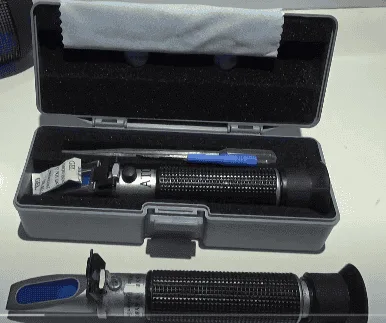
Budget Category: SE DEF Refractometer ($20-40)
The SE DEF Refractometer represents excellent value for occasional users including individual diesel truck owners, RV operators, or small contractors with one or two diesel vehicles.
Specifications:
- Measurement range: 15-40% urea concentration
- Resolution: 0.5% graduations
- Accuracy: ±0.5% at 20°C
- Automatic Temperature Compensation (ATC): 10-30°C (50-86°F)
- Weight: 6.4 ounces
- Dimensions: Approximately 7" × 2" × 2"
- Warranty: 12 months
- Includes: Refractometer body, adjustment screwdriver, pipette, protective case, cleaning cloth, instruction manual
Performance strengths include adequate accuracy for DEF quality verification (±0.5% accuracy easily identifies DEF outside acceptable 31.5-33.5% range), lightweight portable design suitable for vehicle storage, ATC feature preventing most temperature-related measurement errors, and complete accessory kit providing everything needed for immediate use.
Limitations reported by users include somewhat difficult initial calibration requiring patience to properly zero the instrument, prism cover latch feeling slightly flimsy (though functional), and instructions that could be clearer for first-time refractometer users.
Best for: Individual vehicle owners needing occasional DEF testing (monthly verification or when purchasing DEF from unfamiliar sources), budget-conscious buyers requiring functional instrument without premium features, and users comfortable with simple mechanical devices and willing to invest time learning proper technique.
User feedback averages 4.3/5 stars across 300+ reviews, with most criticism centering on calibration learning curve rather than measurement accuracy or durability issues once users master technique.
Mid-Range Category: OTC 5025 DEF Refractometer ($60-90)
The OTC (Owatonna Tool Company) 5025 represents over 95 years of automotive tool manufacturing experience, providing professional-grade accuracy and construction at modest price premium over budget units.
Specifications:
- Measurement range: 15-40% urea concentration with 20°C waterline reference
- Resolution: 0.5% graduations
- Accuracy: ±0.2% (tighter tolerance than budget units)
- Automatic Temperature Compensation: 10-30°C
- Weight: 7.2 ounces
- Warranty: Limited lifetime warranty on materials and workmanship
- Construction: Precision optical components, anodized aluminum body
Performance strengths include precision optics providing clearer, sharper shadow line definition than budget units, improved accuracy (±0.2% vs ±0.5%) useful for critical applications requiring high confidence, durable construction withstanding professional shop environment abuse, and the reassurance of lifetime warranty from established tool brand.
Limitations noted by users include packaging sometimes arriving with missing accessories (pipette or screwdriver), though OTC customer service replaces these promptly, and short pipette length making sample collection from tight spaces (like vehicle DEF tanks) moderately difficult without extension.
Best for: Professional mechanics and diesel technicians testing DEF regularly, fleet maintenance operations with moderate testing volumes (5-20 tests weekly), and serious diesel enthusiasts wanting professional-grade accuracy without digital unit costs.
User feedback averages 4.7/5 stars across nearly 50 reviews, with 92% positive ratings praising reliability, accuracy, and clear readability. Common praise includes "works exactly as expected," "accurate and easy to read," and "good investment for diesel maintenance."
Premium Category: Digital Refractometers ($200-400)
High-end digital DEF refractometers from manufacturers like MISCO, Atago, and others provide features justifying costs for high-volume applications.
Typical specifications:
- Measurement range: 0-50% urea or broader
- Resolution: 0.1% (finer than analog units)
- Accuracy: ±0.1% (best available)
- Temperature compensation: Automatic across wide range (-10 to 50°C typical)
- Display: LCD showing numerical concentration value
- Memory: Result storage on advanced models
- Connectivity: USB or Bluetooth data export on premium models
- Measurement time: 2-3 seconds
- Power: Rechargeable battery or AAA batteries
- Warranty: 12-24 months typically
Performance strengths include objective numerical readings eliminating interpretation variability, rapid measurement cycles enabling high-throughput testing (important for truck stops testing dozens of vehicles daily), digital record-keeping capability supporting quality management systems, automatic calibration on some models reducing operator error, and suitability for operators with vision limitations preventing accurate analog scale reading.
Limitations include substantial cost ($200-400 range), battery dependence requiring charging infrastructure or replacement batteries, more complex electronics creating potential failure modes not present in simple analog units, and sensitivity to rough handling potentially damaging delicate components.
Best for: Commercial truck stops and high-volume fueling facilities testing hundreds of DEF samples weekly, large fleet operations with centralized maintenance facilities, DEF suppliers and distributors requiring quality verification before bulk deliveries, and operations requiring digital documentation for quality assurance or regulatory compliance.
Example: Digital Refractometer with TruckFaultCodes.com Subscription
Some premium digital refractometers include value-added services like diagnostic code database subscriptions. These bundles provide comprehensive diesel diagnostic capability beyond simple DEF testing, potentially including access to extensive fault code libraries (100,000+ codes covering all major diesel engine manufacturers), repair information and common fixes for specific codes, mobile app access for field diagnostics, and technical support resources.
While initial cost of $300-400 seems substantial, operations already subscribing to diagnostic databases may find bundled offerings provide overall value when database subscription costs ($150-300 annually typical) are factored into total ownership calculations.
Interpreting Refractometer Results and Problem Diagnosis
Understanding what different readings mean enables effective problem diagnosis and quality management.
Acceptable DEF Quality Range
The ISO 22241 specification defining DEF quality establishes 32.5% ±0.7% as acceptable urea concentration, yielding 31.8-33.2% acceptable range. In practice, slightly wider tolerances of 31.5-33.5% (±3% relative tolerance) are commonly used for field testing accounting for instrument accuracy limitations and minor variation from ideal conditions.
Readings between 31.5-33.5% indicate acceptable DEF quality suitable for vehicle use without concerns. This DEF should provide proper SCR system operation, adequate NOx conversion efficiency, and no risk of crystallization or inadequate dosing.
Low Concentration Readings
Readings below 31.5% indicate diluted DEF from water contamination, improper manufacturing, degradation from extended storage, biological contamination (bacteria or algae consuming urea), or deliberate dilution by unscrupulous parties.
The consequences of using diluted DEF include insufficient ammonia generation preventing complete NOx conversion, emission standard violations potentially triggering engine derate, increased DEF consumption as systems inject more fluid attempting to compensate, "DEF quality" warning lights or fault codes, and potential emission test failures in jurisdictions with diesel emission testing.
Actions required when detecting low concentration include not using the suspect DEF in any vehicle, draining and flushing any vehicle DEF tanks that received the contaminated fluid, notifying suppliers about quality problems (supporting this with documented refractometer readings), and sourcing replacement DEF from reliable suppliers with documented quality control.
High Concentration Readings
Readings above 33.5% indicate DEF with excessive urea from improper manufacturing, water evaporation during storage (particularly in partially filled containers exposed to heat), or intentional over-concentration attempting to "improve" performance (misguided and dangerous).
The consequences of using concentrated DEF include crystallization within injectors, lines, and pumps as urea precipitates from over-saturated solution, dosing module damage from crystalline deposits, uneven DEF decomposition in exhaust creating hotspots that may damage components, SCR catalyst contamination from improper ammonia distribution, and potential clogging of DEF filters and screens.
Actions required include not using over-concentrated DEF, carefully flushing any systems exposed to it before crystallization occurs, and understanding that once crystallization begins, simply diluting back to proper concentration may not redissolve all precipitated urea—requiring thorough system flushing with proper-concentration DEF.
Severely Abnormal Readings
Readings outside 25-40% range indicate either gross contamination, completely wrong fluid in the container, or refractometer problems.
Readings near 0-5% suggest nearly pure water, indicating either complete dilution destroying any effectiveness, wrong fluid entirely (perhaps water was mistakenly placed in DEF container), or refractometer calibration problems requiring recalibration with distilled water.
Readings at scale extremes (approaching 40%+) indicate gross over-concentration or possibly contamination with other fluids that might raise refractive index dramatically. Diesel fuel contamination, for instance, would create abnormal readings outside typical scales.
Verification when encountering extreme readings includes testing a known-good DEF sample from factory-sealed container confirming refractometer accuracy, recalibrating the refractometer and retesting, testing the suspect sample with a different refractometer if available for cross-reference, and considering laboratory analysis if contamination is suspected but refractometer can't definitively characterize it.
DEF Storage, Handling, and Quality Management Best Practices
Proper DEF management prevents contamination and maintains quality from supplier through vehicle use.
Storage Requirements
Temperature control represents the primary storage consideration. DEF freezes at 12°F (-11°C) and begins degrading at temperatures above approximately 77°F (25°C), with degradation accelerating substantially above 86°F (30°C). Ideal storage temperature ranges 50-77°F (10-25°C).
Container selection requires materials compatible with DEF's slightly corrosive nature. Acceptable materials include high-density polyethylene (HDPE—the standard for DEF containers), polypropylene, stainless steel (304 or 316 grades), and enamel or glass-lined steel. Unacceptable materials include copper and copper alloys (brass, bronze), carbon steel without protective coating, aluminum, and zinc-galvanized steel—all of which DEF corrodes or contaminates.
Light protection prevents photodegradation of urea. DEF containers should be opaque or stored in dark locations, as UV light accelerates urea decomposition gradually reducing concentration over months of exposure.
Sealed storage prevents both water evaporation (which would increase concentration) and water intrusion from condensation or precipitation (which would decrease concentration). Containers should have tight-fitting caps and bulk tanks should have sealed fill ports and vents with desiccant breathers preventing moisture entry.
Shelf life under proper storage conditions (50-77°F in sealed containers away from light) typically extends 12-24 months from manufacturing. DEF stored in poor conditions (hot environments, direct sunlight, unsealed containers) may degrade in 6 months or less. Most packaging includes "sell by" or "use by" dates that should be respected.
Handling Procedures
Clean equipment is essential for preventing contamination. All pumps, transfer hoses, funnels, and containers contacting DEF must be dedicated to DEF use only—never use equipment that has contacted fuel, oil, coolant, or other fluids even if subsequently cleaned, as trace contamination can cause problems.
Personal protection is minimal given DEF's non-toxic nature, but gloves prevent skin drying from DEF's mildly alkaline pH, and eye protection provides sensible precaution during transfer operations where splashing could occur.
Spill cleanup is straightforward as DEF is non-hazardous. Wipe spills promptly (DEF is slightly corrosive to some materials when left in contact), rinse with water, and avoid allowing DEF to dry on surfaces where it will leave white crystalline residue requiring more vigorous cleaning.
Transfer procedures should minimize DEF exposure to air (reducing contamination opportunities) and prevent introduction of foreign material. When adding DEF to vehicles, use clean funnels or direct connection from containers to vehicle fill necks, avoiding procedures where DEF might contact dirty vehicle surfaces or be exposed to environmental contaminants.
Quality Verification Programs
Incoming inspection of bulk DEF deliveries should include refractometer testing of representative samples before accepting delivery. Document results and reject any delivery failing to meet specifications, notifying the supplier and documenting the rejection with test data.
Periodic monitoring of stored DEF (monthly minimum for bulk storage, quarterly for smaller operations) tracks quality over time and identifies degradation or contamination before it affects vehicles. Test from multiple tank locations (top, middle, bottom) as stratification can occur, and maintain logs documenting test dates, readings, and any corrective actions.
Supplier qualification should include requiring laboratory analysis certificates for bulk deliveries, verifying supplier ISO 22241 certification and quality system implementation, and conducting periodic audits of supplier facilities and processes for critical fleet applications.
Corrective action procedures when problems are detected include immediate quarantine of suspect DEF preventing vehicle use, investigation to determine root cause (contamination source, storage condition problems, supplier issues), correction of identified problems before returning to service, and verification testing confirming correction effectiveness.
Additional Resources for DEF Quality and SCR Systems
For comprehensive information about DEF specifications and quality standards, the ISO 22241 standard series (parts 1-5) provides definitive requirements accessible through standards organizations or technical libraries.
Understanding SCR system operation and maintenance, vehicle manufacturer service information provides model-specific guidance addressing DEF tank locations, system component descriptions, diagnostic procedures, and maintenance requirements specific to your vehicle.
Conclusion: Essential Tool for Modern Diesel Operation
DEF refractometers—whether simple $25 analog units for individual owners or sophisticated $400 digital instruments for commercial operations—represent essential quality assurance tools preventing expensive SCR system damage from contaminated or degraded DEF while providing peace of mind that the fluid enabling legal, compliant diesel operation actually meets specifications. The relatively modest instrument costs, ranging from less than the cost of a single DEF tank fill-up to roughly equivalent to one SCR injector replacement, provide outstanding value given the potential damage costs of contaminated DEF and the increasing dependence of modern diesel vehicles on properly functioning SCR systems.
Understanding proper refractometer operation—including careful calibration with distilled water before testing, proper sample application and temperature consideration, and accurate reading interpretation—ensures reliable results preventing both false alarms (rejecting good DEF based on measurement errors) and false security (accepting contaminated DEF due to improper testing). The procedures outlined here, while requiring initial learning investment, become routine after several practice sessions and provide confidence in testing results that supports effective DEF quality management.
The broader context of DEF quality management—proper storage preventing degradation, clean handling preventing contamination, supplier qualification ensuring reliable sources, and periodic monitoring identifying problems before they affect vehicles—extends beyond simple refractometer testing to comprehensive quality assurance programs protecting diesel vehicle investments. However, the refractometer represents the essential measurement tool enabling all other quality management activities by providing objective, quantitative assessment of urea concentration.
For diesel vehicle owners, mechanics, fleet operators, and anyone involved in modern diesel technology, DEF refractometers have transitioned from obscure laboratory instruments to essential practical tools as fundamental to diesel operation as fuel filters or oil. The ability to verify DEF quality in seconds anywhere a sample can be obtained—at bulk delivery acceptance, during routine maintenance, when investigating DEF-related fault codes, or simply for periodic verification—provides control over a critical consumable that many diesel operators previously accepted on faith from suppliers and distributors.
By investing in appropriate refractometer technology, learning proper testing procedures, implementing quality verification programs, and maintaining proper DEF storage and handling practices, diesel operators can effectively eliminate DEF quality as a source of problems, focusing attention on the numerous other maintenance and operational considerations that modern diesel vehicles require while ensuring the SCR emission control systems enabling diesel's continued viability operate as designed throughout vehicle service lives.
